South African Botanical Registry

African Ashwagandha

Withania somnifera
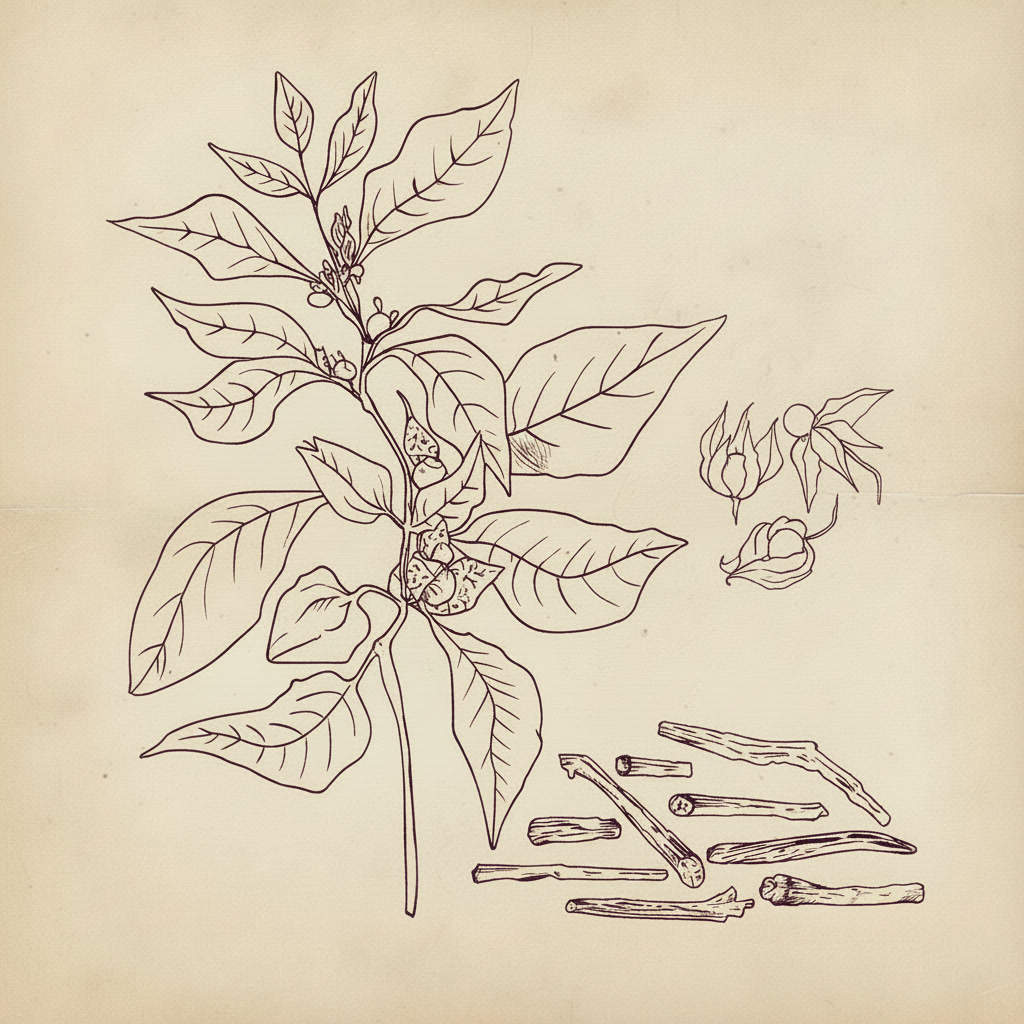
← back Explore
Photo Credit
John van der Berg · Cederberg Nature Reserve · March 2024
Common Names
Afrikaans
Geneesblaarbossie · Slaapbossie
English
African Ashwagandha · Winter Cherry
Khoikhoi
not documented
Ndebele
not documented
San
not documented
Sepedi
not documented
Sesotho
ubuhlungu
Setswana
not documented
Swati
not documented
Tsonga
not documented
Venda
not documented
Xhosa
ubuvimba
Zulu
ubuvimba
Sanskrit (global trade)
Ashwagandha
Common Name
African Ashwagandha
Scientific Name
Withania somnifera
Family
Solanaceae
Native Region
Northern Cape, Limpopo, and North West Province — also native to India, North Africa, and the Mediterranean, with South African ecotypes distinct in phytochemical profile
Annual
Production
50–200 t
Export Revenue
R5–20m
Export Markets
EU, UK, USA
Livelihoods
200–500
Protection & Benefit Sharing
No GI No GI protection. South African ecotype differentiation research ongoing.
No BSA No formal agreement. Khoikhoi communities in Northern Cape have undocumented traditional knowledge claims.
Organic Small certified organic production in Northern Cape. Growing demand from EU nutraceutical sector.
Wild Harvest Mix of wild harvest and semi-cultivation. Cultivation protocols under development.
Provinces
ECEastern Cape
FSFree State
GTGauteng
KZNKwaZulu-Natal
LIMLimpopo
MPMpumalanga
NCNorthern Cape
NWNorth West
WCWestern Cape
Key
Registered farm
Certified organic
Introduction

Withania somnifera, known globally as Ashwagandha and locally as African Ashwagandha or Geneesblaarbossie, is one of the most extensively researched medicinal plants in the world. While the Indian variety dominates global trade, the South African ecotype has attracted growing scientific attention for its distinct phytochemical composition, particularly its withanolide concentration and stress-response adaptogenic properties. The plant grows as a woody shrub in dry, rocky soils across the northern regions of South Africa and has been used by Khoisan and Sotho communities for centuries. Global demand for Ashwagandha has surged dramatically since 2020, driven by the wellness industry's focus on stress, sleep, and cognitive performance. South Africa is uniquely positioned to supply a certified African-origin product to premium markets in Europe, the USA, and Asia. Research collaborations between South African universities and international pharmaceutical companies are actively investigating the local ecotype's commercial and therapeutic potential.

Active Compounds
  • Withanolides (steroidal lactones — primary bioactives)
  • Withaferin A
  • Alkaloids (isopelletierine, anaferine)
  • Saponins
  • Iron (high concentration in root)
Traditional Uses
  • Root powder used as a general tonic and energy restorative
  • Applied in treatment of anxiety, insomnia, and nervous exhaustion
  • Used for male reproductive health and fertility
  • Taken during convalescence after illness or surgery
  • Applied topically for joint pain and inflammation
Clinically Validated
  • Significant reduction in serum cortisol levels in double-blind RCT (Chandrasekhar et al., 2012)
  • Improved sleep quality and onset in clinical trial (Langade et al., 2019)
  • Withaferin A demonstrates anti-tumour activity in multiple in vitro and animal studies
  • Adaptogenic and anti-stress effects well established across more than 200 peer-reviewed studies
Cultivation

Arid to semi-arid. Tolerates drought, poor soils, and high temperatures. Sensitive to waterlogging. Rainfall 200–500mm per annum.

Northern Cape, Limpopo, North West Province — particularly Namaqualand and the Bushveld

Commercial & Trade Notes

Small-scale certified cultivation underway in Limpopo supplying the local herbal industry. Export-grade production is nascent but growing. Indian imports currently dominate the South African retail market.

Indigenous Knowledge

Khoisan communities of the Northern Cape used Withania somnifera root as a strengthening tonic, particularly for the elderly and those recovering from illness. The Sotho people knew the plant as a treatment for fever and as a sedative for restless children. Root preparations were typically dried, powdered, and mixed with milk or animal fat. In some communities the berries were used to curdle milk, a practice also documented in traditional Indian use. The plant occupies a quiet but consistent place in South African ethnobotany — less celebrated than Buchu or Rooibos but deeply embedded in the healing traditions of dryland communities.

Health & Wellness
Articles for African Ashwagandha are being curated.
Subscribe to be notified when this section launches.
Innovation & R&D · Free
"Global withanolide extraction patents are being filed at pace. South African researchers at the University of Pretoria are characterising the local ecotype's unique withanolide fingerprint with a view to geographic origin certification — similar to the Rooibos GI model."
Intelligence summary for African Ashwagandha.
Withania somnifera, known globally as Ashwagandha and locally as African Ashwagandha or Geneesblaarbossie, is one of the most extensively researched medicinal plants in the world. While the Indian variety dominates global trade, the South African ecotype has attracted growing scientific attention for its distinct phytochemical composition, particularly its withanolide concentration and stress-response adaptogenic properties. The plant grows as a woody shrub in dry, rocky soils across the northern regions of South Africa and has been used by Khoisan and Sotho communities for centuries. Global demand for Ashwagandha has surged dramatically since 2020, driven by the wellness industry's focus on stress, sleep, and cognitive performance. South Africa is uniquely positioned to supply a certified African-origin product to premium markets in Europe, the USA, and Asia. Research collaborations between South African universities and international pharmaceutical companies are actively investigating the local ecotype's commercial and therapeutic potential.
Link sent →
Innovation & R&D · Free
Intelligence bulletin — African Ashwagandha
SABM Registry analysis.
One of the world's most researched adaptogenic plants — the South African ecotype is gaining recognition as a distinct and potent variety with unique withanolide profiles suited to the local climate.
Link sent →
IK & Heritage
Articles for African Ashwagandha are being curated.
Subscribe to be notified when this section launches.
Culture
Articles for African Ashwagandha are being curated.
Subscribe to be notified when this section launches.
Agronomy · Free
"Well suited to dryland and smallholder farming systems. Root harvest at 150–180 days. Minimal water requirements make it viable under climate stress scenarios projected for the Northern Cape."
Intelligence summary for African Ashwagandha.
Withania somnifera, known globally as Ashwagandha and locally as African Ashwagandha or Geneesblaarbossie, is one of the most extensively researched medicinal plants in the world. While the Indian variety dominates global trade, the South African ecotype has attracted growing scientific attention for its distinct phytochemical composition, particularly its withanolide concentration and stress-response adaptogenic properties. The plant grows as a woody shrub in dry, rocky soils across the northern regions of South Africa and has been used by Khoisan and Sotho communities for centuries. Global demand for Ashwagandha has surged dramatically since 2020, driven by the wellness industry's focus on stress, sleep, and cognitive performance. South Africa is uniquely positioned to supply a certified African-origin product to premium markets in Europe, the USA, and Asia. Research collaborations between South African universities and international pharmaceutical companies are actively investigating the local ecotype's commercial and therapeutic potential.
Link sent →
Agronomy · Free
Intelligence bulletin — African Ashwagandha
SABM Registry analysis.
One of the world's most researched adaptogenic plants — the South African ecotype is gaining recognition as a distinct and potent variety with unique withanolide profiles suited to the local climate.
Link sent →
Legislation
Articles for African Ashwagandha are being curated.
Subscribe to be notified when this section launches.
Projects
Articles for African Ashwagandha are being curated.
Subscribe to be notified when this section launches.
Intelligence Pulse
Articles for African Ashwagandha are being curated.
Subscribe to be notified when this section launches.