South African Botanical Registry

Buchu

Agathosma betulina
← back Explore
Photo Credit
John van der Berg · Cederberg Nature Reserve · March 2024
Common Names
Afrikaans
Boegoe · Rondeblaarboegoe
English
Round Leaf Buchu · Buchu
Khoikhoi
boegoe
Ndebele
not documented
San
not documented
Sepedi
not documented
Sesotho
not documented
Setswana
not documented
Swati
not documented
Tsonga
not documented
Venda
not documented
Xhosa
ibuchu
Zulu
ibhokwe
Common Name
Buchu
Scientific Name
Agathosma betulina
Family
Rutaceae
Native Region
Endemic to the Western Cape — found exclusively in the Cederberg, Hex River Mountains, and Langeberg ranges in the fynbos biome, typically at altitudes of 400–1500m
Annual
Production
300–600 t
Export Revenue
R80–150m
Export Markets
USA, Germany, France
Livelihoods
3,000–5,000
Protection & Benefit Sharing
GI Pending Geographical Indication application in progress. Will legally protect the Khoikhoi-origin name and Western Cape geographic designation in international markets.
No BSA No formal agreement. The word buchu is Khoikhoi in origin — one of the few indigenous plant names to survive colonialism intact into global trade.
Organic Significant certified organic production. Premium prices for organic certified leaf in pharmaceutical and flavour markets.
Wild Harvest Predominantly cultivated. Wild harvest historically depleted stocks. Now regulated with permit requirements.
Provinces
ECEastern Cape
FSFree State
GTGauteng
KZNKwaZulu-Natal
LIMLimpopo
MPMpumalanga
NCNorthern Cape
NWNorth West
WCWestern Cape
Key
Registered farm
Certified organic
Introduction

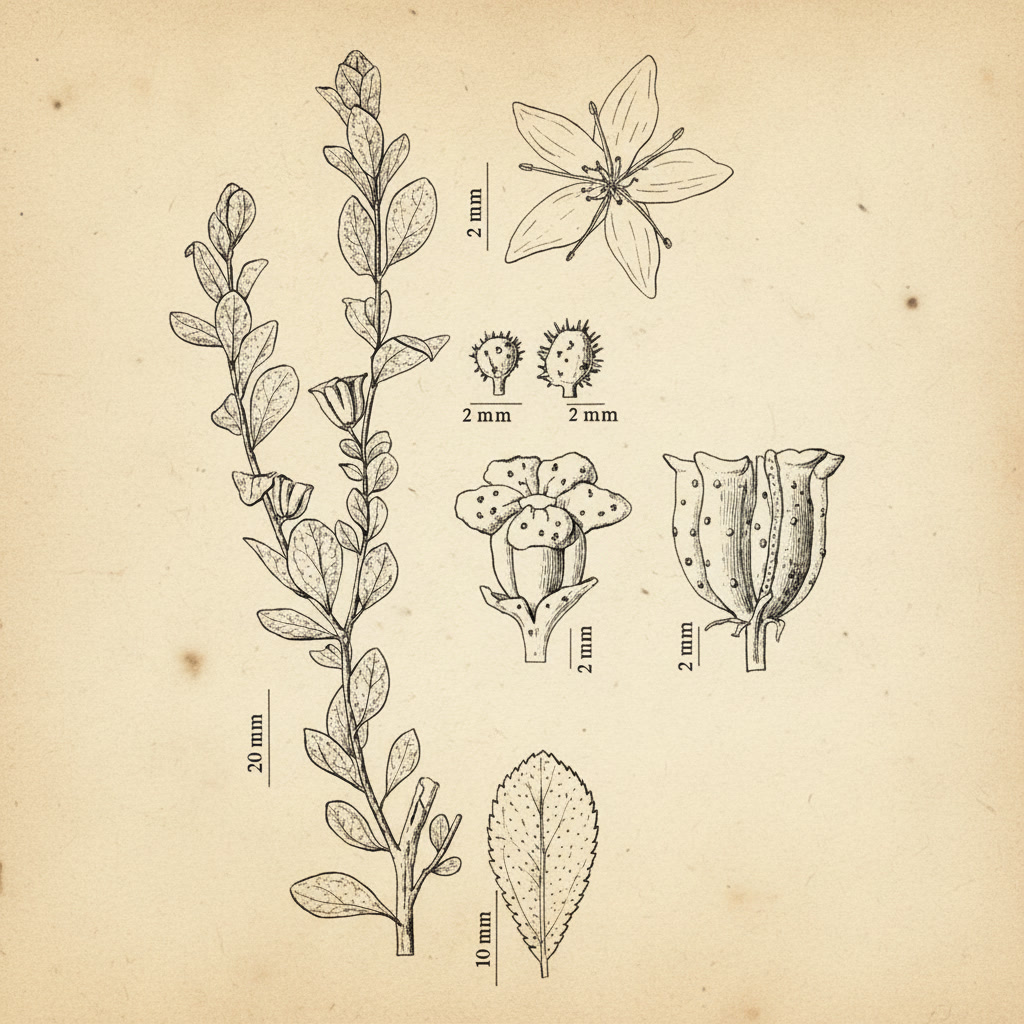
Agathosma betulina, commonly known as Round Leaf Buchu or simply Buchu, is one of the most commercially significant and historically documented medicinal plants in South Africa. Endemic to the Western Cape fynbos, it has been harvested and traded since the Khoikhoi first introduced it to Dutch settlers at the Cape in the 1650s. By the 18th century Buchu was being exported to Europe as a urinary tract remedy and flavouring agent, and it remains a major South African botanical export today. The plant is a small woody shrub with small round leaves that contain prominent oil glands — when crushed they release a distinctive blackcurrant and peppermint aroma caused by the unique compound diosphenol. South Africa holds a near-monopoly on global Buchu supply as the plant grows nowhere else on earth in meaningful quantities. The industry is regulated, certified, and increasingly focused on sustainability as wild fynbos populations face pressure from agriculture, invasive species, and climate change. Buchu is used in urinary health supplements, digestive preparations, natural flavourings, and high-end cosmetics worldwide.

Active Compounds
  • Diosphenol (primary bioactive — antibacterial and diuretic)
  • Pulegone
  • Isopulegone
  • Limonene
  • Flavonoids (diosmin, hesperidin, rutin)
  • Mucilage
Traditional Uses
  • Leaf infusion taken as a diuretic and urinary tract antiseptic
  • Used to treat kidney and bladder infections
  • Brandy tincture taken for stomach complaints and digestive disorders
  • Applied topically for bruises, sprains, and rheumatic pain
  • Used as a general tonic and anti-inflammatory by Khoikhoi communities
  • Buchu brandy was a standard remedy in Cape households for over two centuries
Clinically Validated
  • Diosphenol confirmed as an effective urinary antiseptic and diuretic agent (Van Wyk et al., 2009)
  • Antibacterial activity against urinary pathogens including E. coli demonstrated in vitro (Moolla & Viljoen, 2008)
  • Anti-inflammatory activity of flavonoid fraction documented in multiple studies
  • Antioxidant capacity confirmed by DPPH assay — significant free radical scavenging activity
Cultivation

Mediterranean fynbos. Requires well-drained, acidic, nutrient-poor soils. Full sun. Frost-tolerant but sensitive to waterlogging. Rainfall 300–600mm per annum concentrated in winter months.

Cederberg Wilderness Area, Hex River Valley, Langeberg and Riviersonderend mountains — all within the Western Cape

Commercial & Trade Notes

Both wild-harvested and cultivated under permit. South Africa exports approximately 500 tonnes of dried Buchu leaf annually. Major export markets include the USA, UK, Germany, and Netherlands. The industry is represented by the Buchu Industry Group and governed by Western Cape conservation regulations. Certified organic and fair-trade production is growing.

Indigenous Knowledge

Buchu's history with the Khoikhoi people of the Western Cape stretches back thousands of years. The plant was used as a body perfume — leaves were mixed with animal fat and applied to the skin in a practice called buchu smearing, used in ceremonial contexts and as insect repellent. Khoikhoi healers used it for urinary complaints, stomach problems, and as a general fortifying tonic. The name Buchu derives from the Khoikhoi word for the plant. When Dutch settlers arrived at the Cape they rapidly adopted Buchu from Khoikhoi knowledge and incorporated it into Cape folk medicine, most famously as Buchu brandy — a tincture of Buchu leaves in Cape brandy that became the universal household remedy for urinary and digestive complaints. This tradition persisted in Afrikaner households well into the 20th century. The Khoikhoi transmission of Buchu knowledge to European settlers represents one of the most clearly documented examples of indigenous knowledge transfer in South African botanical history.

Health & Wellness
Articles for Buchu are being curated.
Subscribe to be notified when this section launches.
Innovation & R&D · Free
"Buchu essential oil is attracting significant interest from the natural fragrance industry as a blackcurrant flavour alternative. Several South African biotech companies are developing standardised diosphenol extracts for urinary health supplements targeting EU and US markets. Research into Buchu's anti-inflammatory properties for topical cosmetic applications is ongoing at Stellenbosch University."
Intelligence summary for Buchu.
Agathosma betulina, commonly known as Round Leaf Buchu or simply Buchu, is one of the most commercially significant and historically documented medicinal plants in South Africa. Endemic to the Western Cape fynbos, it has been harvested and traded since the Khoikhoi first introduced it to Dutch settlers at the Cape in the 1650s. By the 18th century Buchu was being exported to Europe as a urinary tract remedy and flavouring agent, and it remains a major South African botanical export today. The plant is a small woody shrub with small round leaves that contain prominent oil glands — when crushed they release a distinctive blackcurrant and peppermint aroma caused by the unique compound diosphenol. South Africa holds a near-monopoly on global Buchu supply as the plant grows nowhere else on earth in meaningful quantities. The industry is regulated, certified, and increasingly focused on sustainability as wild fynbos populations face pressure from agriculture, invasive species, and climate change. Buchu is used in urinary health supplements, digestive preparations, natural flavourings, and high-end cosmetics worldwide.
Link sent →
Innovation & R&D · Free
Intelligence bulletin — Buchu
SABM Registry analysis.
South Africa's most famous fynbos export — a small aromatic shrub whose leaves have been traded internationally for over 300 years and remain a cornerstone of the global herbal medicine, cosmetic, and flavour industries.
Link sent →
IK & Heritage
Articles for Buchu are being curated.
Subscribe to be notified when this section launches.
Culture
Articles for Buchu are being curated.
Subscribe to be notified when this section launches.
Agronomy · Free
"Cultivation is well established in the Cederberg and Hex River areas. Plants reach harvestable maturity in 3 years. Harvest of young leafy stems is non-destructive. Certified organic production commands a significant price premium. Water-wise cultivation methods are being refined as the Western Cape faces increasing drought pressure."
Intelligence summary for Buchu.
Agathosma betulina, commonly known as Round Leaf Buchu or simply Buchu, is one of the most commercially significant and historically documented medicinal plants in South Africa. Endemic to the Western Cape fynbos, it has been harvested and traded since the Khoikhoi first introduced it to Dutch settlers at the Cape in the 1650s. By the 18th century Buchu was being exported to Europe as a urinary tract remedy and flavouring agent, and it remains a major South African botanical export today. The plant is a small woody shrub with small round leaves that contain prominent oil glands — when crushed they release a distinctive blackcurrant and peppermint aroma caused by the unique compound diosphenol. South Africa holds a near-monopoly on global Buchu supply as the plant grows nowhere else on earth in meaningful quantities. The industry is regulated, certified, and increasingly focused on sustainability as wild fynbos populations face pressure from agriculture, invasive species, and climate change. Buchu is used in urinary health supplements, digestive preparations, natural flavourings, and high-end cosmetics worldwide.
Link sent →
Agronomy · Free
Intelligence bulletin — Buchu
SABM Registry analysis.
South Africa's most famous fynbos export — a small aromatic shrub whose leaves have been traded internationally for over 300 years and remain a cornerstone of the global herbal medicine, cosmetic, and flavour industries.
Link sent →
Legislation
Articles for Buchu are being curated.
Subscribe to be notified when this section launches.
Projects
Articles for Buchu are being curated.
Subscribe to be notified when this section launches.
Intelligence Pulse
Articles for Buchu are being curated.
Subscribe to be notified when this section launches.