South African Botanical Registry

Devil's Claw

Harpagophytum procumbens
← back Explore
Photo Credit
John van der Berg · Cederberg Nature Reserve · March 2024
Common Names
Afrikaans
Duiwelsklou · Kloubossie
English
Devil's Claw · Grapple Plant
Khoikhoi
not documented
Ndebele
not documented
San
not documented
Sepedi
sengaparile
Sesotho
sengaparile
Setswana
sengaparile
Swati
not documented
Tsonga
not documented
Venda
not documented
Xhosa
not documented
Zulu
not documented
Common Name
Devil's Claw
Scientific Name
Harpagophytum procumbens
Family
Pedaliaceae
Native Region
Kalahari Desert and semi-arid savanna of the Northern Cape, North West Province, and Botswana — thriving in deep Kalahari sand at altitudes of 1000–1300m
Annual
Production
~800 t
Export Revenue
R60–120m
Export Markets
Germany, France, UK
Livelihoods
5,000–10,000
Protection & Benefit Sharing
CITES II CITES Appendix II — export permits required and sustainable harvest verification mandatory. European Medicines Agency traditional use registration confirmed 2023.
No BSA No formal agreement. San and Sotho communities whose knowledge underpins the global industry receive no formal royalties. Ongoing advocacy linked to Hoodia precedent.
Organic Certified organic wild harvest available from Northern Cape. Commands premium in EU herbal medicine market.
Wild Harvest Entirely wild-harvested. Secondary tubers regenerate if harvested correctly but takes 3–5 years. TRAFFIC sustainable harvest guidelines in place.
Provinces
ECEastern Cape
FSFree State
GTGauteng
KZNKwaZulu-Natal
LIMLimpopo
MPMpumalanga
NCNorthern Cape
NWNorth West
WCWestern Cape
Key
Registered farm
Certified organic
Introduction

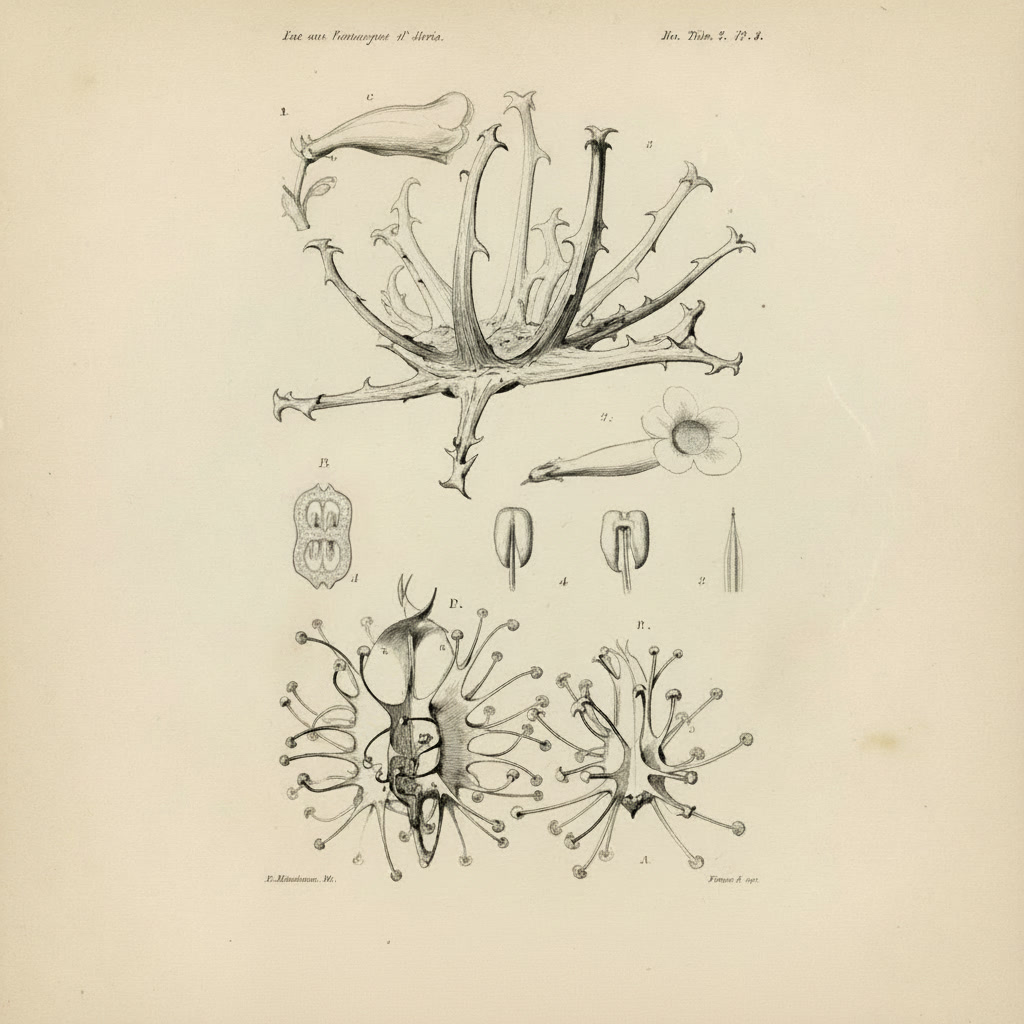
Harpagophytum procumbens, known as Devil's Claw or Grapple Plant, is one of the most extensively researched and commercially significant medicinal plants in southern Africa. The plant takes its dramatic name from its woody fruit, covered in long hooked claws that entangle in the fur and hooves of passing animals for seed dispersal. It grows as a low-spreading perennial in the deep red sands of the Kalahari, producing striking tubular pink to purple flowers and developing large primary and secondary tubers that can reach 1.5 metres deep in the sand. These tubers — harvested, dried, and sliced — have been used by San and Khoi communities for centuries to treat pain, fever, and digestive complaints. Devil's Claw entered European herbal medicine in the early 20th century through German colonial research in Namibia and is now one of the top-selling herbal medicines in Germany, France, and the UK, primarily for arthritis, back pain, and musculoskeletal inflammation. South Africa and Namibia are the world's primary sources, and the export industry is worth tens of millions of rands annually.

Active Compounds
  • Harpagoside (primary iridoid glycoside — anti-inflammatory bioactive)
  • Harpagide
  • Procumbide
  • Beta-sitosterol
  • Flavonoids (luteolin, kaempferol)
  • Triterpenes (oleanolic acid, ursolic acid)
Traditional Uses
  • Tuber decoction taken for arthritis, rheumatism, and joint pain
  • Used for fever, malaria, and general pain relief
  • Taken for digestive complaints including loss of appetite and dyspepsia
  • Applied topically for skin lesions, boils, and ulcers
  • Used during pregnancy for pain management by San communities
  • Taken as a bitter tonic for liver and gallbladder support
Clinically Validated
  • Harpagoside demonstrated significant COX-2 inhibition — anti-inflammatory mechanism comparable to NSAIDs (Fiebich et al., 2001)
  • Reduction in chronic low back pain confirmed in multiple randomised controlled trials (Chrubasik et al., 2003)
  • Efficacy for osteoarthritis of the hip and knee demonstrated in systematic review (Brien et al., 2006)
  • Improvement in pain scores and mobility in rheumatoid arthritis patients in open clinical study
  • Approved as a traditional herbal medicine for musculoskeletal pain by the European Medicines Agency
Cultivation

Arid Kalahari sand. Extremely drought-tolerant. Full sun. Deep well-drained sandy soils essential. Cannot tolerate waterlogging. Rainfall 200–400mm per annum.

Northern Cape (Kalahari Gemsbok area), North West Province, and across the border into Botswana and Namibia

Commercial & Trade Notes

Predominantly wild-harvested under permit in South Africa, Namibia, and Botswana. South Africa exports approximately 800 tonnes of dried tuber annually. The industry is regulated by DAFF and provincial conservation authorities. Cultivation trials have been conducted but commercial plantation production remains unestablished due to the plant's slow growth and deep tuber development.

Indigenous Knowledge

The San people of the Kalahari have used Harpagophytum procumbens as a medicine for thousands of years. The secondary tubers were dug from deep in the sand — a laborious process requiring knowledge of the plant's growth patterns and the right season for harvest. San healers prepared decoctions of the dried and sliced tuber for pain, fever, and digestive complaints. The bitter taste was considered a sign of potency. Pregnant San women used dilute preparations for pain management during labour — though this use is now contraindicated in herbal medicine guidelines due to the plant's uterine stimulant potential. The introduction of Devil's Claw to European medicine came through German farmer Georg Mehnert, who learned of the plant's properties from Namibian San and Khoi communities in the early 1900s and sent samples to Germany — one of the most directly traceable pathways of indigenous knowledge transfer into Western herbal medicine. Benefit-sharing frameworks for the San communities whose knowledge underpins this global industry remain inadequate and are a subject of ongoing advocacy.

Health & Wellness
Articles for Devil's Claw are being curated.
Subscribe to be notified when this section launches.
Innovation & R&D · Free
"Harpagoside extraction and standardisation technology is well advanced. Several European pharmaceutical companies are developing next-generation Devil's Claw formulations with enhanced bioavailability. Research into combination preparations with Boswellia and Willow Bark for musculoskeletal pain is ongoing. A transdermal harpagoside patch is in development at a German herbal pharmaceutical company."
Intelligence summary for Devil's Claw.
Harpagophytum procumbens, known as Devil's Claw or Grapple Plant, is one of the most extensively researched and commercially significant medicinal plants in southern Africa. The plant takes its dramatic name from its woody fruit, covered in long hooked claws that entangle in the fur and hooves of passing animals for seed dispersal. It grows as a low-spreading perennial in the deep red sands of the Kalahari, producing striking tubular pink to purple flowers and developing large primary and secondary tubers that can reach 1.5 metres deep in the sand. These tubers — harvested, dried, and sliced — have been used by San and Khoi communities for centuries to treat pain, fever, and digestive complaints. Devil's Claw entered European herbal medicine in the early 20th century through German colonial research in Namibia and is now one of the top-selling herbal medicines in Germany, France, and the UK, primarily for arthritis, back pain, and musculoskeletal inflammation. South Africa and Namibia are the world's primary sources, and the export industry is worth tens of millions of rands annually.
Link sent →
Innovation & R&D · Free
Intelligence bulletin — Devil's Claw
SABM Registry analysis.
The Kalahari's most powerful anti-inflammatory — a creeping desert plant whose hooked fruit gave it its fearsome name, and whose tubers have become one of the most clinically validated herbal medicines for arthritis and pain management in the world.
Link sent →
IK & Heritage
Articles for Devil's Claw are being curated.
Subscribe to be notified when this section launches.
Culture
Articles for Devil's Claw are being curated.
Subscribe to be notified when this section launches.
Agronomy · Free
"Wild harvest sustainability is the primary concern. Secondary tubers regenerate if harvested correctly but the process takes 3–5 years. TRAFFIC and WWF have published sustainable harvest guidelines for the Kalahari region. Cultivation in deep sandy soils is technically feasible but economically challenging due to the depth of tuber development and slow growth rate."
Intelligence summary for Devil's Claw.
Harpagophytum procumbens, known as Devil's Claw or Grapple Plant, is one of the most extensively researched and commercially significant medicinal plants in southern Africa. The plant takes its dramatic name from its woody fruit, covered in long hooked claws that entangle in the fur and hooves of passing animals for seed dispersal. It grows as a low-spreading perennial in the deep red sands of the Kalahari, producing striking tubular pink to purple flowers and developing large primary and secondary tubers that can reach 1.5 metres deep in the sand. These tubers — harvested, dried, and sliced — have been used by San and Khoi communities for centuries to treat pain, fever, and digestive complaints. Devil's Claw entered European herbal medicine in the early 20th century through German colonial research in Namibia and is now one of the top-selling herbal medicines in Germany, France, and the UK, primarily for arthritis, back pain, and musculoskeletal inflammation. South Africa and Namibia are the world's primary sources, and the export industry is worth tens of millions of rands annually.
Link sent →
Agronomy · Free
Intelligence bulletin — Devil's Claw
SABM Registry analysis.
The Kalahari's most powerful anti-inflammatory — a creeping desert plant whose hooked fruit gave it its fearsome name, and whose tubers have become one of the most clinically validated herbal medicines for arthritis and pain management in the world.
Link sent →
Legislation
Articles for Devil's Claw are being curated.
Subscribe to be notified when this section launches.
Projects
Articles for Devil's Claw are being curated.
Subscribe to be notified when this section launches.
Intelligence Pulse
Articles for Devil's Claw are being curated.
Subscribe to be notified when this section launches.