Hoodia
Hoodia gordonii
Production
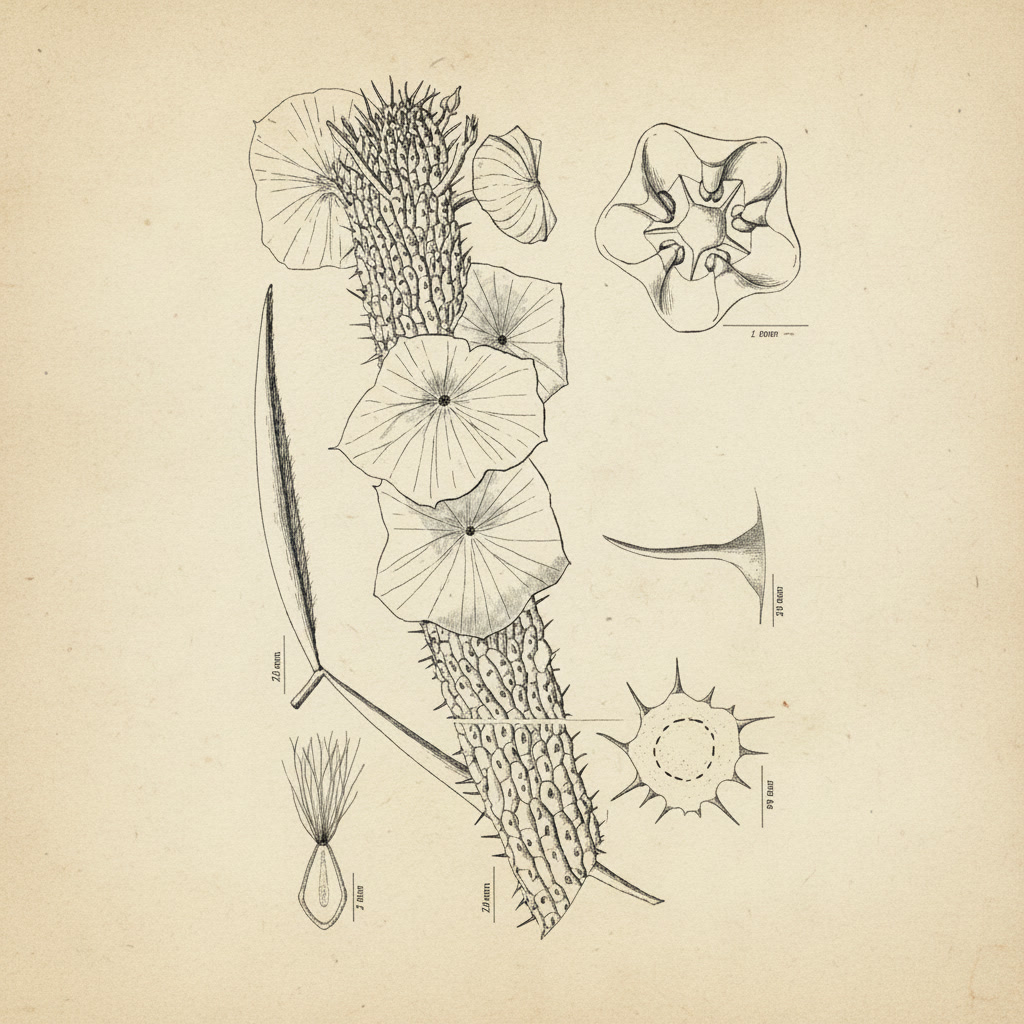
Hoodia gordonii is one of the most extraordinary plants in the SABM registry — not only for its remarkable pharmacological properties but for the legal and ethical watershed its commercialisation created in international indigenous knowledge law. A large spiny succulent resembling a cactus, it grows slowly in the harshest deserts of the Northern Cape and Namibia, producing large pale pink to purple flowers with a distinctive carrion smell that attracts fly pollinators. San hunter-gatherers of the Kalahari have chewed the bitter stems for thousands of years to suppress hunger and thirst during long hunting expeditions — a practice that caught the attention of researchers at the CSIR in the 1960s. The active compound P57 — a steroidal glycoside that tricks the brain into feeling full — was isolated and patented by the CSIR in 1995 and subsequently licensed to Unilever for hundreds of millions of dollars as a potential obesity treatment. The San people, whose traditional knowledge had guided the entire research pathway, received nothing. The legal battle that followed resulted in a landmark benefit-sharing agreement in 2003 — the first of its kind in the world — that returned a percentage of royalties to the San community and directly influenced the drafting of the Nagoya Protocol on Access and Benefit Sharing. Hoodia's story is inseparable from the global conversation about indigenous knowledge rights.
- P57 (oxypregnane steroidal glycoside — primary appetite suppressant bioactive)
- Hoodigogenin A
- Calogenin glycosides
- Pregnane glycosides (multiple)
- Fresh stem chewed to suppress hunger and thirst during long hunts
- Used as an energy sustainer during periods of food scarcity
- Applied topically for minor skin infections and abscesses
- Taken for severe abdominal cramps and indigestion
- Used as a general tonic for physical endurance
- P57 demonstrated significant appetite suppression through hypothalamic ATP modulation in animal studies (MacLean & Luo, 2004)
- Human pilot trial showed reduced caloric intake in obese volunteers consuming Hoodia extract (Whelan et al., 2010)
- Unilever Phase II clinical trial discontinued due to safety concerns around liver enzyme elevation at high doses — highlighting the importance of appropriate dosing
- Anti-diabetic potential of pregnane glycosides demonstrated in preliminary studies
- Antimicrobial activity against several bacterial strains documented in vitro
Hyper-arid desert and semi-desert. Extremely drought-tolerant. Full sun. Deep well-drained sandy or gravelly soils essential. Cannot tolerate frost or waterlogging. Rainfall 50–200mm per annum.
Northern Cape — Bushmanland, Namaqualand, and the Richtersveld — also Namibia and southern Botswana
Hoodia is a CITES Appendix II listed species — all trade requires permits and sustainability verification. Commercial cultivation has been established in the Northern Cape and Namibia to supply the supplement industry. Wild harvesting is restricted. The supplement market has contracted significantly since Unilever abandoned its P57 development programme, but niche appetite suppressant supplements continue to be sold globally.
The San people of the Kalahari have known and used Hoodia gordonii for thousands of years. Hunting parties would carry sections of stem on long expeditions into the desert, chewing them to suppress the urge to eat and drink and extend their range. The practice was so embedded in San survival knowledge that it was passed down through generations as essential hunting preparation. When CSIR researchers first documented this use in the 1960s following observation of San communities, they did not seek consent or acknowledge the source of their research lead. The patent on P57 was filed without any reference to San traditional knowledge. The legal challenge mounted by the South African San Council in the early 2000s, with support from international indigenous rights organisations, forced a renegotiation that resulted in the 2003 benefit-sharing agreement — the first time a commercial entity had formally acknowledged and compensated indigenous knowledge holders for a pharmaceutical development. This agreement is now taught in international law, bioethics, and indigenous rights courses worldwide and directly informed Articles 5 and 12 of the Nagoya Protocol adopted in 2010.