Pepper Bark
Warburgia salutaris
Production
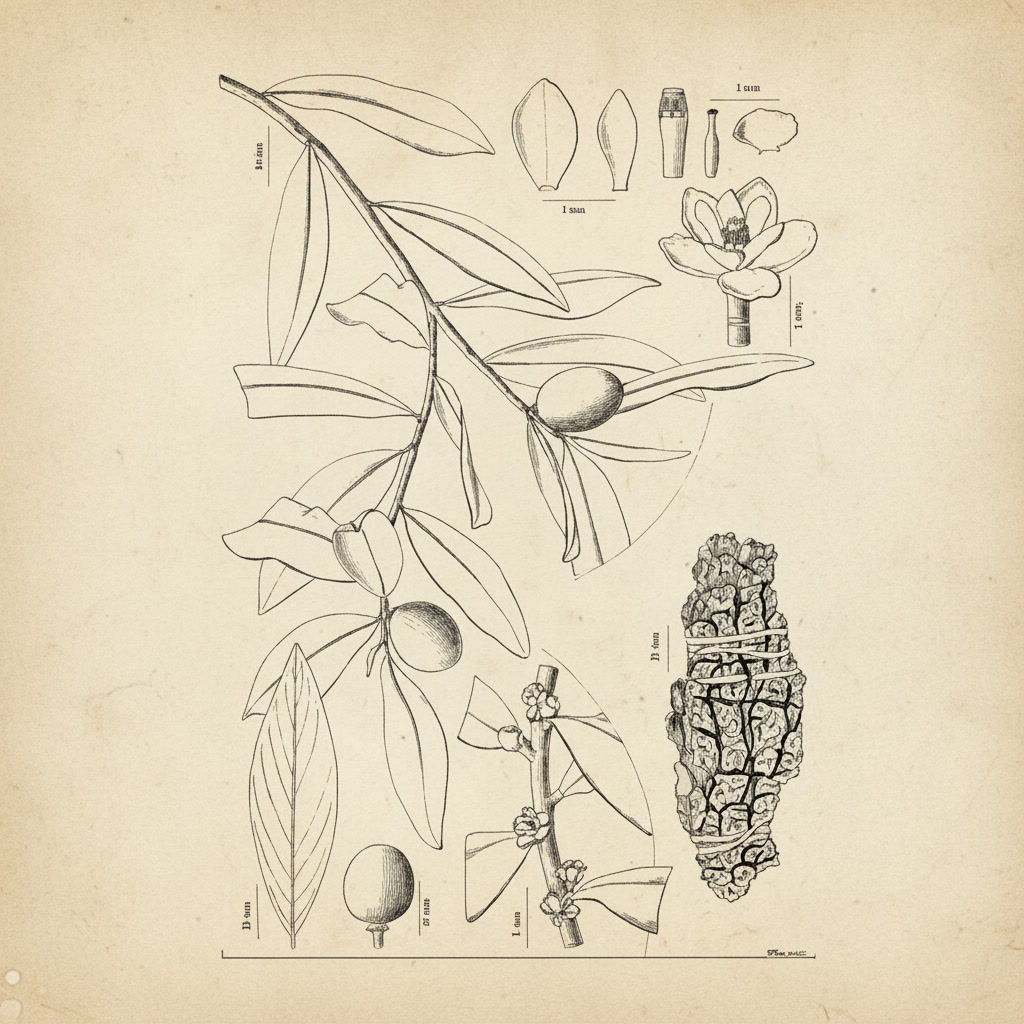
Warburgia salutaris, known as Pepper Bark Tree, Isibhaha in Zulu, or Mulanga in Venda, is one of the most medicinally significant and critically endangered trees in southern Africa. A medium to large evergreen tree with glossy dark green leaves and smooth grey bark, it grows in the subtropical forests and bushveld margins of Limpopo, Mpumalanga, and KwaZulu-Natal. The bark has an intensely hot, peppery taste caused by its high concentration of drimane sesquiterpenes — compounds with remarkable antimicrobial, antifungal, and anti-inflammatory properties. Pepper Bark is among the highest-demand medicinal plants in South African muthi markets and is used across Zulu, Venda, Tsonga, Swazi, and Ndebele traditional medicine systems for a wide range of conditions. This demand, combined with the tree's slow growth and preference for specific forest habitats, has led to catastrophic overharvesting — entire trees are stripped of bark, killing them, and wild populations have collapsed in many areas. Warburgia salutaris is now listed as Endangered on the South African National Biodiversity Institute's Red List, and urgent conservation and cultivation programmes are underway to prevent its extinction from accessible areas.
- Warburganal (drimane sesquiterpene dialdehyde — primary bioactive)
- Muzigadial (drimane sesquiterpene)
- Polygodial
- Ugandensidial
- Isovelleral
- Tannins and phenolic compounds
- Bark decoction taken for colds, flu, and respiratory infections
- Used as a treatment for malaria and fever
- Taken for stomach complaints, diarrhoea, and intestinal parasites
- Applied topically for skin infections, wounds, and fungal conditions
- Used for headaches and sinus complaints — bark chewed or inhaled
- Taken for sexually transmitted infections
- Used in ritual and ceremonial contexts as a protective medicine
- Warburganal demonstrated potent antimicrobial activity against Staphylococcus aureus and drug-resistant strains (Kubo et al., 1994)
- Antifungal activity against Candida albicans and dermatophytes confirmed in multiple studies
- Anti-inflammatory activity of drimane sesquiterpenes documented in vitro
- Antiprotozoal activity against Plasmodium falciparum (malaria) demonstrated — consistent with traditional use (Nundkumar & Ojewole, 2002)
- Antiviral activity against Herpes simplex virus confirmed in preliminary studies
Subtropical to warm temperate forest margins. Requires well-drained fertile soils with organic matter. Semi-shade to full sun. Sensitive to hard frost. Rainfall 600–1200mm per annum.
KwaZulu-Natal coastal and midlands forests, Limpopo bushveld and escarpment forests, Mpumalanga lowveld — also cultivated in community and botanical gardens across the region
Predominantly wild-harvested — and this is the core conservation crisis. Commercial cultivation is in early stages, led by SANBI, the South African National Biodiversity Institute, and several university programmes. Trees take 8–12 years to reach bark-harvestable size. A small number of community nurseries in Limpopo and KwaZulu-Natal are producing seedlings for replanting programmes.
Warburgia salutaris holds a position of exceptional importance across multiple traditional medicine systems in southern Africa. Zulu izinyanga regard Isibhaha bark as one of the most powerful medicines available — a primary treatment for respiratory infections, particularly in winter when demand peaks dramatically. Venda healers use Mulanga in compound preparations for malaria, fever, and protective spiritual medicines. Tsonga communities use it for stomach and intestinal complaints. The bark's intensely peppery heat is interpreted in many traditions as evidence of the plant's power — a direct sensory signal of its medicinal strength. The crisis of overharvesting is deeply felt by traditional healers who are themselves witnessing the disappearance of trees they have relied upon for generations. Many izinyanga report travelling increasingly long distances to source Pepper Bark as local populations are exhausted. The tension between the urgent medical needs of communities who rely on traditional medicine and the conservation imperative to protect a critically endangered species is one of the most complex challenges in South African ethnobotany today.