South African Botanical Registry

Wild Olive

Olea europaea subsp. africana
← back Explore
Photo Credit
John van der Berg · Cederberg Nature Reserve · March 2024
Common Names
Afrikaans
Olienhout · Wilde Olyfboom
English
Wild Olive · Ironwood Olive
Khoikhoi
not documented
Ndebele
umquma
San
not documented
Sepedi
mohlware
Sesotho
mohlware
Setswana
morolwe
Swati
umquma
Tsonga
ndzhovhela
Venda
muloiwa
Xhosa
umquma
Zulu
umquma
Common Name
Wild Olive
Scientific Name
Olea europaea subsp. africana
Family
Oleaceae
Native Region
Widespread across South Africa — Western Cape, Eastern Cape, KwaZulu-Natal, Limpopo, Mpumalanga, and Gauteng — growing in coastal forests, bushveld, rocky hillsides, and riverine margins at altitudes of 0–2200m
Annual
Production
< 50 t
Export Revenue
R5–20m
Export Markets
EU, USA
Livelihoods
Limited
Protection & Benefit Sharing
No GI No GI protection. Significant underutilised commercial potential. No formal industry association yet established.
No BSA No formal agreement. Zulu communities associate umquma with spiritual protection. Knowledge distributed across multiple language communities.
Organic Small certified organic leaf extract production.
Wild Harvest Primarily wild-harvested leaves. No sustainability concerns at current minimal commercial scale.
Provinces
ECEastern Cape
FSFree State
GTGauteng
KZNKwaZulu-Natal
LIMLimpopo
MPMpumalanga
NCNorthern Cape
NWNorth West
WCWestern Cape
Key
Registered farm
Certified organic
Introduction

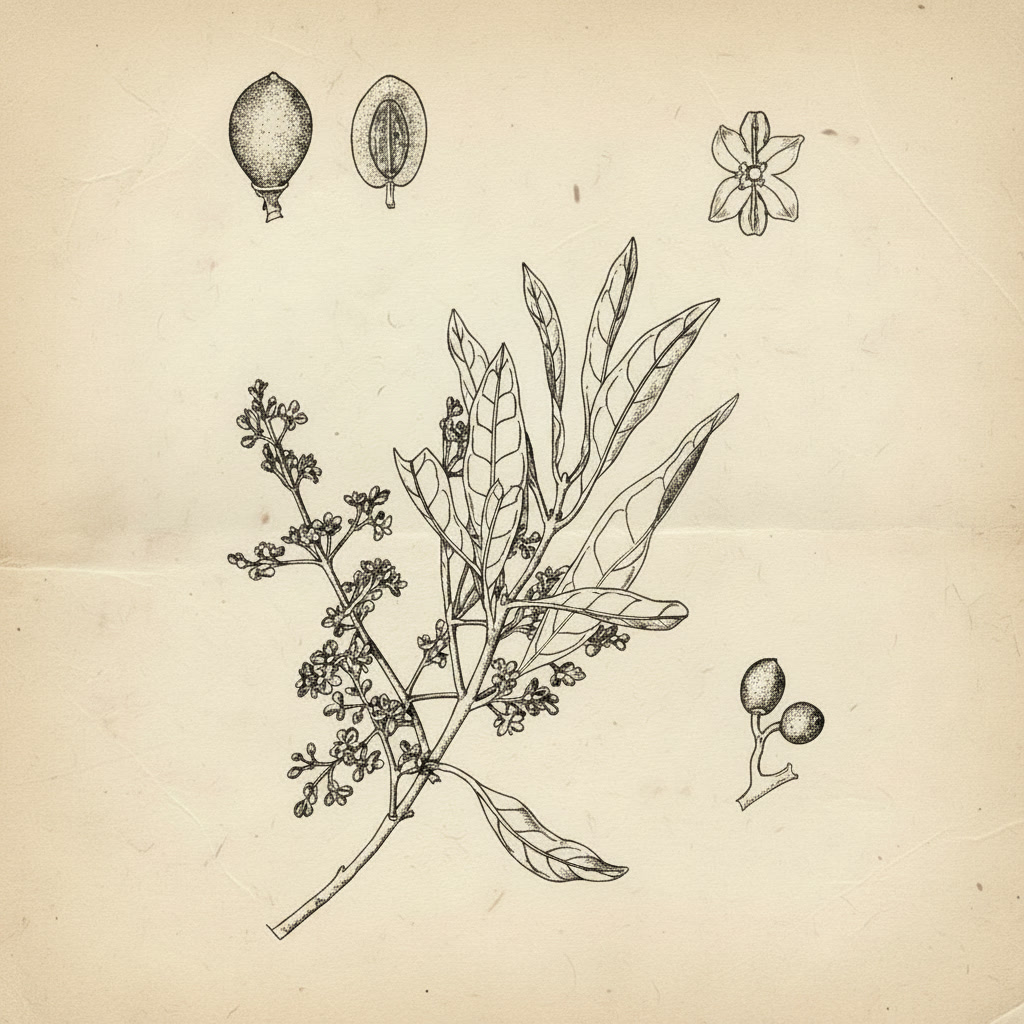
Olea europaea subsp. africana, known as Wild Olive, Umquma in Zulu, or Olienhout in Afrikaans, is the indigenous African subspecies of the olive tree and one of the most widely distributed and ecologically significant trees in South Africa. Unlike its cultivated Mediterranean relative, the Wild Olive grows across an extraordinary range of habitats — from coastal dune forest to highveld rocky outcrops, riverine bush to dry bushveld — making it one of the most adaptable trees in the South African flora. It is a slow-growing, extremely long-lived evergreen with small leathery leaves, clusters of tiny white flowers, and small purple-black fruits that are relished by birds and wildlife. The tree has been used by virtually every South African cultural group for medicine, food, timber, and spiritual purposes. Its leaves contain oleuropein — the same bitter polyphenol responsible for the celebrated cardiovascular and antidiabetic properties of Mediterranean olive leaf — in concentrations comparable to or exceeding commercial olive leaf products. This has attracted significant scientific and commercial interest as the global olive leaf supplement market has grown to over USD 500 million annually. South Africa's Wild Olive represents an untapped opportunity to develop a certified African-origin olive leaf product with authentic indigenous knowledge credentials and proven phytochemical potency.

Active Compounds
  • Oleuropein (primary secoiridoid polyphenol — cardiovascular and antidiabetic bioactive)
  • Hydroxytyrosol (phenolic antioxidant)
  • Oleacein and oleocanthal
  • Flavonoids (luteolin, apigenin, rutin)
  • Triterpenoids (oleanolic acid, ursolic acid)
  • Tannins
Traditional Uses
  • Leaf infusion taken for high blood pressure and cardiovascular complaints
  • Used as a treatment for diabetes and blood sugar regulation
  • Bark decoction taken for fever and malaria
  • Leaf preparations used for urinary tract infections
  • Applied topically for wounds, skin infections, and joint pain
  • Fruit eaten as a food source and taken as a digestive tonic
  • Wood burned as a ritual purification agent in Zulu and Xhosa ceremonies
Clinically Validated
  • Oleuropein demonstrated significant ACE inhibitory activity — relevant to blood pressure management (Hansen et al., 1996)
  • Antidiabetic activity confirmed — oleuropein stimulates insulin secretion and improves glucose uptake in vitro
  • Antimicrobial activity against a broad spectrum of bacterial and fungal pathogens confirmed
  • Anti-inflammatory activity of oleuropein and hydroxytyrosol well documented in Mediterranean olive research — directly applicable to Wild Olive
  • Antioxidant capacity of Wild Olive leaf confirmed comparable to commercial Mediterranean olive leaf products (Briesen et al., 2019)
Cultivation

Extremely adaptable — from Mediterranean coastal to highveld conditions. Drought-tolerant once established. Tolerates moderate frost. Well-drained soils preferred. Rainfall 300–900mm per annum.

Cultivated across all South African provinces as a garden and street tree. Wild populations in all major biomes. Commercial leaf harvest potential exists across a wide geographic range.

Commercial & Trade Notes

Not yet commercially harvested for leaf extract in South Africa. Timber is used for furniture and crafts — Olienhout is one of the hardest and most beautiful South African hardwoods. Fruit is harvested informally by communities and wildlife. Commercial olive leaf extract production represents a significant untapped opportunity.

Indigenous Knowledge

Olea europaea subsp. africana is woven into the fabric of South African cultural life across every major tradition. Zulu communities know Umquma as a tree of protection — branches are placed at homestead entrances to ward off evil and the wood is used in protective ritual preparations by izangoma. Xhosa healers use bark and leaf preparations for fever and infection. Sotho communities use the leaf infusion for hypertension — a use that precisely parallels the clinically validated cardiovascular activity of oleuropein. Afrikaner communities valued Olienhout for its extraordinary timber — dense, hard, and beautifully grained — and used leaf infusions as a household remedy for fever and blood pressure. San communities ate the small fruits and used the wood for digging sticks and implements. The tree's presence across virtually the entire South African landscape means it has been a constant resource for every community that has lived here. Its spiritual significance as a protective tree in Nguni traditions adds a dimension to its cultural value that extends well beyond its medicinal and material uses.

Health & Wellness
Articles for Wild Olive are being curated.
Subscribe to be notified when this section launches.
Innovation & R&D · Free
"Wild Olive leaf oleuropein content is being characterised by researchers at the University of Pretoria and Stellenbosch University with a view to developing a certified South African olive leaf extract product. The global olive leaf supplement market — valued at over USD 500 million — represents an immediate commercial opportunity. Hydroxytyrosol extraction for cosmetic antioxidant applications is being explored by several Cape Town-based natural cosmetic companies."
Intelligence summary for Wild Olive.
Olea europaea subsp. africana, known as Wild Olive, Umquma in Zulu, or Olienhout in Afrikaans, is the indigenous African subspecies of the olive tree and one of the most widely distributed and ecologically significant trees in South Africa. Unlike its cultivated Mediterranean relative, the Wild Olive grows across an extraordinary range of habitats — from coastal dune forest to highveld rocky outcrops, riverine bush to dry bushveld — making it one of the most adaptable trees in the South African flora. It is a slow-growing, extremely long-lived evergreen with small leathery leaves, clusters of tiny white flowers, and small purple-black fruits that are relished by birds and wildlife. The tree has been used by virtually every South African cultural group for medicine, food, timber, and spiritual purposes. Its leaves contain oleuropein — the same bitter polyphenol responsible for the celebrated cardiovascular and antidiabetic properties of Mediterranean olive leaf — in concentrations comparable to or exceeding commercial olive leaf products. This has attracted significant scientific and commercial interest as the global olive leaf supplement market has grown to over USD 500 million annually. South Africa's Wild Olive represents an untapped opportunity to develop a certified African-origin olive leaf product with authentic indigenous knowledge credentials and proven phytochemical potency.
Link sent →
Innovation & R&D · Free
Intelligence bulletin — Wild Olive
SABM Registry analysis.
Africa's native olive — a tough, long-lived evergreen tree that has provided food, medicine, timber, and spiritual protection to South African communities for millennia, and whose leaves are now attracting global pharmaceutical interest for cardiovascular and antidiabetic applications.
Link sent →
IK & Heritage
Articles for Wild Olive are being curated.
Subscribe to be notified when this section launches.
Culture
Articles for Wild Olive are being curated.
Subscribe to be notified when this section launches.
Agronomy · Free
"Extremely adaptable and low-maintenance once established. Slow-growing but very long-lived. Leaf harvest is non-destructive and can be repeated multiple times per year. Suitable for cultivation across a wide range of South African climate zones. Commercial leaf harvest from existing urban and farm trees could supply an initial extract industry without new planting."
Intelligence summary for Wild Olive.
Olea europaea subsp. africana, known as Wild Olive, Umquma in Zulu, or Olienhout in Afrikaans, is the indigenous African subspecies of the olive tree and one of the most widely distributed and ecologically significant trees in South Africa. Unlike its cultivated Mediterranean relative, the Wild Olive grows across an extraordinary range of habitats — from coastal dune forest to highveld rocky outcrops, riverine bush to dry bushveld — making it one of the most adaptable trees in the South African flora. It is a slow-growing, extremely long-lived evergreen with small leathery leaves, clusters of tiny white flowers, and small purple-black fruits that are relished by birds and wildlife. The tree has been used by virtually every South African cultural group for medicine, food, timber, and spiritual purposes. Its leaves contain oleuropein — the same bitter polyphenol responsible for the celebrated cardiovascular and antidiabetic properties of Mediterranean olive leaf — in concentrations comparable to or exceeding commercial olive leaf products. This has attracted significant scientific and commercial interest as the global olive leaf supplement market has grown to over USD 500 million annually. South Africa's Wild Olive represents an untapped opportunity to develop a certified African-origin olive leaf product with authentic indigenous knowledge credentials and proven phytochemical potency.
Link sent →
Agronomy · Free
Intelligence bulletin — Wild Olive
SABM Registry analysis.
Africa's native olive — a tough, long-lived evergreen tree that has provided food, medicine, timber, and spiritual protection to South African communities for millennia, and whose leaves are now attracting global pharmaceutical interest for cardiovascular and antidiabetic applications.
Link sent →
Legislation
Articles for Wild Olive are being curated.
Subscribe to be notified when this section launches.
Projects
Articles for Wild Olive are being curated.
Subscribe to be notified when this section launches.
Intelligence Pulse
Articles for Wild Olive are being curated.
Subscribe to be notified when this section launches.